| Today my thoughts flashed back
to December last year when we were in Cairo, prior to the
start of our expedition, shooting many of the preliminary
IMAX shots that will be used in the upcoming IMAX movie “Mystery
of the Nile”. I remember sitting on the 10th floor of
the Sheraton Gezira Hotel in the heart of Cairo staring at
the Nile as it flowed through on its way to the Mediterranean
and wondering what it would feel like and what I would be
thinking when we finally did pass through in our little rafts
after having actually run the entire Nile from its source
in Ethiopia down to Cairo. It was, I thought, going to be
so exciting to arrive in Cairo after months of camping out
on the Nile.
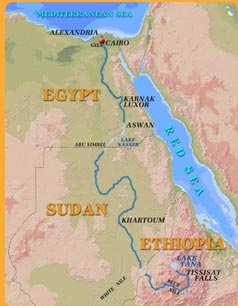
Well, four days ago, after 4,993 kms and 108 river days,
we finally made it to Cairo. We motored into Cairo after having
run 1025 kms in 9 days from Aswan at the head of Lake Nasser
in Upper Egypt, clear through Middle Egypt and then down to
the beginning of the Nile Delta. Upon entering Cairo, with
its 17-22 million inhabitants, I had no feelings of excitement
at all. In fact, all I could think about was how much I wish
I was out of Cairo and back up floating the Nile of The Sudan
and Ethiopia.
Since entering Egypt below Lake Nasser and the Aswan High
Dam we have been subjected to continuous police escort, almost
been run over by 200 tourist cruise ships, and have had to
struggle every day to find anywhere at all to set up a camp
to cook and spend the night. We have been kept up almost every
night by outrageously loud sounds emanating from the almost
continuous riverside development that lines both sides of
the Egyptian Nile clear from Aswan to the Mediterranean. The
all-night sounds (on both banks of the Nile) of passing trains,
highway truck traffic, blaring car horns, all night wedding
parties, people screaming and arguing, dogs barking, the 4:00
a.m. Moslem call to prayer, etc, etc have all managed to keep
us awake more than asleep. It is, therefore, no wonder that
we decided that it was much easier just staying on the river,
with the outboard motors blazing and heading to Cairo rather
than to spend much time visiting the villages along the way.
Don’t get me wrong. The people in Egypt have been,
for the most part, wonderful people. They are incredibly polite
and helpful and the all of the men on the Nile River Police
escorts that we have had continuously clear down the river
have been honest, professional, tremendous to work with and
have actually been a lot of help and assistance. Due to the
complete lack of any campsites along the river (sand for beaches
and sandbars is no longer being carried down the Nile but
is, instead, trapped up in Lake Nasser) we had to actually
camp out at several police stations in many of the larger
cities along the way and the local police commanders have
been wonderful hosts. Down from Aswan and Luxor on the Nile
in Upper and Middle Egypt there is so much water Hyacinth
(an exotic aquatic plant that grows and spreads out incredibly
fast) on the river that it is virtually impossible to pull
off the river in many places. Since the Nile no longer floods
much of the trash, plant matter, and debris that end up in
the Nile are no longer washed down river but just accumulate
along the river banks and in the slower moving eddys. We have
had to fight our way through short sections of river that
is just about completely blocked by the hyacinth. In several
sections of the river the smell of raw sewage being dumped
into the river is just about overwhelming.
It is just astounding and mind boggling how different the
Blue Nile and Nile River is in the three countries that it
flows through on its, 5,400 km journey to the sea. Attached
are three photos from the Nile in the three countries. I think
you can identify which countries they are taken in.
Ethiopia is a wild country full of imposing mountains, canyons
and rapids. Virtually no one lives along Nile and it flows
unimpeded and free for 1,200 kms, just as it has for thousands
of years. In Sudan the Nile is a big wide desert river with
huge sandbars and lined with palm trees and desert jebels
visible far in the distance. Many people live along the river
in The Sudan but mostly just small farmers spread out in small
villages. For 2,300 kms we rafted through The Sudan sleeping
entirely on the millions of sandbars that line the entire
course of the river. In both countries we were free to float
the Nile pretty much un-noticed and un-controlled.
In Egypt the Nile is more than just a ribbon of water flowing
through unimpeded and un-noticed. It is the life blood of
the Egyptians and it is where virtually every one of the 70
million Egyptians lives. It is just about completely controlled,
starting with the Aswan High Dam in the south and extending
past the numerous water irrigation and diversion dams situated
all along the river ending at the Mediterranean Sea 1,000
kms to the north. The Nile may flow through Ethiopia and the
Sudan, but it is used by the Egyptians. At no place along
the entire Nile while it is in Egypt is the Great River even
remotely similar to what is was jut 50 years ago. This is
mainly because of the Aswan High Dam, which backs the Nile
up from Aswan clear back into The Sudan. Behind the High Dam
is trapped the Nile sand and silt that gives the Nile its
color and character in Ethiopia and The Sudan. This has also
given the Egyptians the ability to control their lives free
from the interference of the Nile’s annual floods and
to expand up and down the river in ways though unimaginable
only a short generation ago.
Of all of the surprises and challenges we have encountered
on this expedition during the last 4 months, none has been
greater or more unexpected than the extreme differences in
character that the Nile (both naturally and man-made) has
presented to us during the last 5,200 kms.
We are currently 193.2 kms north of Cairo in the middle of
the Nile Delta in a small town called Disuc. In the last two
days since leaving Cairo and motoring north we have been able
to cover 64.2 kms and 129 kms in two days of motoring. According
to my calculations we are situated 70 kms from the mouth of
the Nile River where it joins the Mediterranean Sea just north
of Rosetta. At a speed of 11.5 kms/hr we will reach the Mediterranean
in six more hours of motoring. This means that at about 2:00
p.m. on Monday, April 26, 2004 we should complete the first
full descent of the Nile River having started at the source
of the Blue Nile at the Springs of Sakala in Ethiopia and
ending 5270 kms and 112 days later at the Mediterranean Sea.
Just 6 more hours…….
PV
------------------------------
Pasquale V Scaturro
Expedition Leader
Nile First Descent Expedition
------------------------------
|